Six Rooms Wake Up – The Imperial Seal Is Lifted at the Shosoin in Nara
Once a year, a door in Nara opens that stays sealed for the other 364 days, and it opens only in the name of the Emperor of Japan. On Thursday, October 1, 2026, the Shosoin treasure house held its Opening Ceremony, the Kaifu no Gi, the annual ritual that lifts the imperial seal from the West Treasure House so its treasures can be inspected. The Imperial Household Agency shared the ceremony on October 16 in a reel on @kunaicho_jp that had gathered 12,623 likes when captured, on an account followed by about 2.5 million people.
A Story by Award Winning Managing Editor His Highness Dr. Prince Mario-Max zu Schaumburg-Lippe.
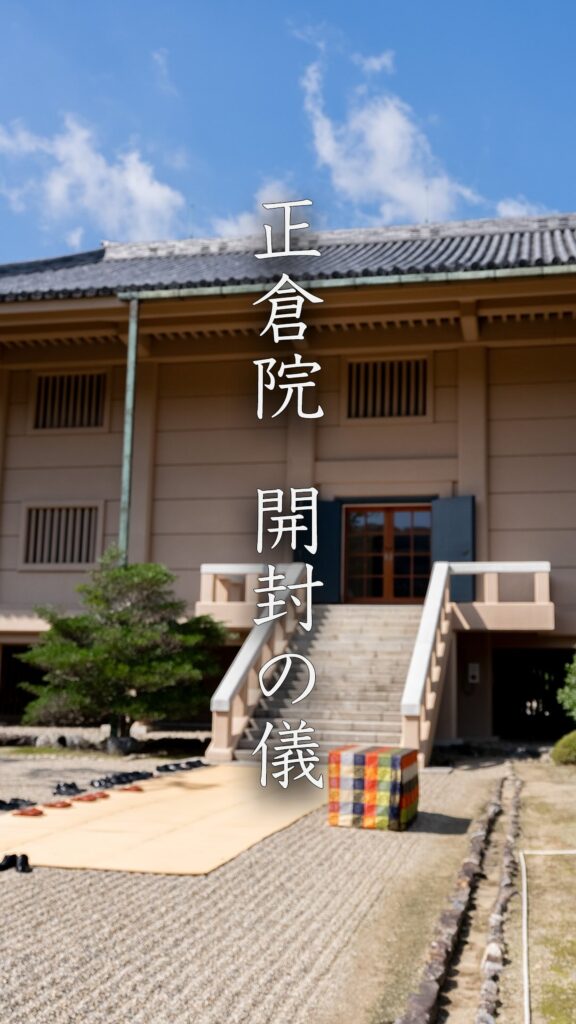
The Agency’s picture is pure Shosoin: the great storehouse under a bright blue sky, tiled roof, pale walls, a flight of steps to its doors, orderly rows of shoes on the gravel, and one joyful splash of colour in the foreground, a box patterned in red, orange, green and blue checks. Vertical lettering down the frame names the day: Shosoin, Opening Ceremony. It looks peaceful. Do not be fooled. This is one of the most disciplined mornings in the Japanese cultural calendar.
Here is what actually happens. The ceremony exists to inspect the Shosoin treasures in the West Treasure House. Once a year the chokufu, the imperial seal placed by order of the Emperor, is released and the storehouse opens. Led by the director of the Shosoin Office, the imperial envoy, the chokushi, enters as the Emperor’s representative. Then the seals on six rooms in total, the six chambers holding the treasures, are lifted, and the envoy confirms there is no problem with the condition in which the treasures have been stored.
And then the marathon begins. After the opening, staff of the Shosoin Office will inspect every treasure before the Closing Ceremony scheduled for Friday, December 4. That is a window of a little over two months, 64 days from opening to closing, in which a whole imperial collection is checked piece by piece. Six rooms. One seal. Sixty-four days of expert eyes.
zeitblatt readers know this treasure house well. Our children reporters story from Nara followed schoolchildren touring the Shosoin and studying faithful reproductions of its treasures for the 78th Shosoin Exhibition. Our GEA report showed Emperor Naruhito and Empress Masako in green before gold in Tokyo. And our September recap of the branch houses traced the wider imperial family from Nairobi to Tokyo. The Shosoin opening is the quiet masterpiece among them: no crowd, no stage, just custody performed perfectly.
The building itself explains the devotion. The Shosoin at Todai-ji in Nara is the imperial treasure house associated with Emperor Shomu of the 8th century. Raised on pillars, its floor lifted clear of the damp ground, it was built to protect silk, metalwork, instruments and court objects across centuries, and it succeeded so well that it became a legend of preservation. The treasures inside connect modern Japan to the Nara court and to the Silk Road world beyond it.
That is the real story behind the seal. Preservation is not only architecture and climate. It is trust, ritual and discipline. A room opened only once a year, only in the Emperor’s name, only before his envoy, is a room nobody enters by accident. The ceremony is the security system, spoken in the language of the court. Its formality is not decoration. Its formality is the work itself.
On December 4, the six rooms will be sealed again and the Shosoin will return to its long quiet year. Until then, in Nara, some of the oldest and most beautiful objects in Japan are being examined one by one, by people whose honour is to hand them on untouched. A seal lifted, a treasure checked, a promise kept for another year.
Photo: @kunaicho_jp
SECHS RÄUME WACHEN AUF! Das Kaiser-Siegel am Shosoin in Nara ist gelüftet
Einmal im Jahr öffnet sich in Nara eine Tür, die an den anderen 364 Tagen versiegelt bleibt – und sie öffnet sich nur im Namen des Kaisers von Japan. Am Donnerstag, 1. Oktober 2026, fand im Shosoin die Öffnungszeremonie statt, das Kaifu no Gi. Das Kaiserliche Hofamt teilte die Zeremonie am 16. Oktober als Video auf @kunaicho_jp, mit 12.623 Likes zum Zeitpunkt der Erfassung und rund 2,5 Millionen Followern.
Das Bild ist Shosoin pur: das große Schatzhaus unter strahlend blauem Himmel, Ziegeldach, helle Wände, eine Treppe zu den Türen, ordentlich aufgereihte Schuhe auf dem Kies – und ein einziger Farbtupfer im Vordergrund, eine Kiste in Rot, Orange, Grün und Blau. Es wirkt friedlich. Doch dieser Morgen gehört zu den diszipliniertesten Terminen im japanischen Kulturkalender.
So läuft es ab: Die Zeremonie dient der Prüfung der Shosoin-Schätze im Westlichen Schatzhaus. Einmal im Jahr wird das Chokufu gelöst, das Kaiser-Siegel, gesetzt auf Befehl des Kaisers, und das Schatzhaus öffnet sich. Angeführt vom Leiter des Shosoin-Amtes betritt der Kaiser-Gesandte, der Chokushi, als Vertreter des Kaisers das Haus. Dann werden die Siegel von insgesamt sechs Räumen gelüftet, und der Gesandte bestätigt, dass die Schätze ohne jeden Schaden verwahrt wurden.
Danach beginnt der Marathon: Bis zur Schließungszeremonie am Freitag, 4. Dezember, prüft das Personal des Shosoin-Amtes jeden einzelnen Schatz. Sechs Räume. Ein Siegel. 64 Tage Expertenarbeit, Stück für Stück.
Das Gebäude selbst erklärt diese Hingabe. Der Shosoin beim Todai-ji in Nara ist das Kaiserliche Schatzhaus, verbunden mit Kaiser Shomu aus dem 8. Jahrhundert. Auf Pfeiler gestellt, der Boden hoch über der feuchten Erde, schützte er Seide, Metallarbeiten, Instrumente und Hofobjekte über Jahrhunderte – so gut, dass er zur Legende der Bewahrung wurde.
Am 4. Dezember werden die sechs Räume wieder versiegelt. Bis dahin werden in Nara einige der ältesten und schönsten Objekte Japans geprüft, eines nach dem anderen. Ein Siegel gelüftet, ein Schatz geprüft, ein Versprechen gehalten – für ein weiteres Jahr.
Foto: @kunaicho_jp
Der Autor ist Award Winning Hollywood Managing-Journalist Seine Hoheit und Exzellenz Dr.iur. Mag.iur. PRINZ MARIO-MAX ZU SCHAUMBURG-LIPPE, MAS, LL.M.
Prinz Mario-Max ist der Sohn der hochfürstlichen Würdenträger Seine Hoheit Dr. h. c. Prinz Waldemar zu Schaumburg-Lippe und Ihrer Hoheit Dr. Prinzessin Antonia zu Schaumburg-Lippe. Seine Großmutter ist Ihre Königliche Hoheit Prinzessin Feodora von Dänemark. Die Familie ist die königlich-dänische Nachoder Linie der Prinzen zu Schaumburg-Lippe, die Gründerfamilie von Hamburg, Lübeck und Kiel.
♔ Instagram: https://www.instagram.com/princemariomax/
Website: http://www.schaumburglippe.org
Facebook Seite: https://www.facebook.com/share/1EsNi5Q1AM/?mibextid=wwXlfr
Facebook: https://www.facebook.com/zuschaumburglippe
X / Twitter: https://twitter.com/schaumburglippe
LinkedIn: https://www.linkedin.com/in/prince-mario-max-schaumburg-lippe-1879978a