Children Reporters at the Shosoin – Schoolchildren Discover Japan’s Imperial Treasure House in Nara
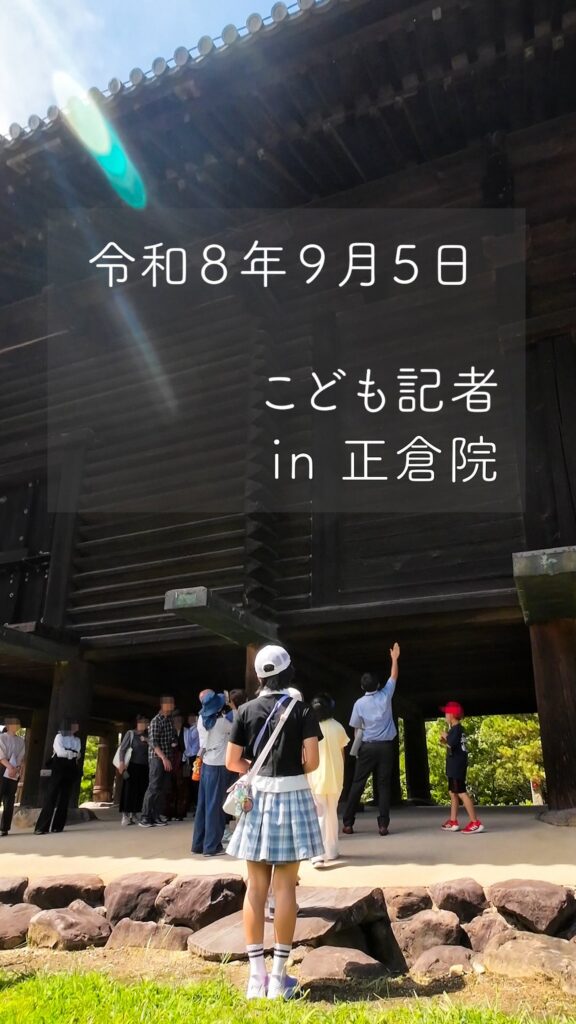
She is perhaps eleven years old, and she has just been given the best assignment in Japanese journalism. A young schoolgirl reporter in a white cap, black top and blue plaid skirt stands before the towering dark timber walls of the Shosoin in Nara, while behind her, children, parents and a guide walk beneath the raised Imperial treasure house, one man pointing up at its ancient beams. The Imperial Household Agency has shared the scene on Instagram, and it is the kind of image that stops a scroll cold: one small reporter, one enormous storehouse, and twelve centuries of history waiting to be interviewed.
A Story by Award Winning Managing Editor His Highness Dr. Prince Mario-Max zu Schaumburg-Lippe.
The day was Children Reporters at the Shosoin, held on Saturday, September 5, 2026, as a related event of the 78th Shosoin Exhibition. The Imperial Household Agency’s Shosoin Office cooperated with the event, in which children from the fifth grade of elementary school to the third grade of junior high school took part together with their parents and guardians. The Agency posted its reel on October 13 to the roughly 2.5 million followers of @kunaicho_jp, and it had collected 9,636 likes when it was captured. The organizers were the Nara National Museum, the Yomiuri Shimbun and Yomiuri TV, with cooperation from the Shosoin Office.
The children toured the Shosoin storehouse itself and faithful reproductions of Shosoin treasures, and through workshops they learned about the history and charm of the treasures. That program is smarter than it first sounds. The storehouse tour gives a child the scale of the place – the raised floor on its tall pillars, the dark log walls, the tiled roof catching the September sun. The reproductions give her the detail, close enough to study without any risk to the originals. And the workshops give her the words. A reporter needs all three: scale, detail and words.
The Shosoin, set at Todai-ji in Nara, is the Imperial treasure house holding treasures associated with Emperor Shomu from the 8th century. Its treasures have survived because generation after generation chose to protect them, and because a building lifted clear of the damp ground did its quiet work century after century. The annual Shosoin Exhibition at the Nara National Museum is one of Japan’s most beloved autumn cultural traditions, and this year it reaches its 78th edition. Seventy-eight autumns of a nation returning to the same storehouse to look, learn and remember.
Readers of zeitblatt.com know how vividly the Imperial Household Agency now tells these stories. Our day-one Aomori report followed the imperial couple at the National Sports Festival, the day-two story caught them cheering from the stands, and the Asian Games celebration in Aichi showed the same warmth on an international stage. The Shosoin children reporters day is the cultural chapter of that same story: an institution opening its doors and trusting the youngest audience in the room.
That trust is the real headline. A child treated as a reporter behaves like one. She looks longer. She asks why. She notices the pillars, the shade, the guide’s raised hand, the way the storehouse seems to float above its visitors. And she goes home with a story to tell, which is precisely how a treasure house that has survived twelve centuries arranges to survive the next one. Not behind locked doors alone, but in the imagination of a girl in a plaid skirt who stood in front of it on a bright September Saturday and decided it was worth reporting on.
By the end of the day, the young reporters had seen the storehouse, studied its reproduced treasures and learned, in workshops built for their age, why these objects still charm Japan after all these years. The exhibition will draw its devoted autumn crowds as it always does. But its future audience was made on September 5, one question at a time.
KINDERREPORTER AM SHOSOIN! Schulmädchen vor dem uralten Schatzhaus – so entdecken Japans jüngste Journalisten 1.200 Jahre Kaisergeschichte
Dieses Bild muss man einfach lieben. Ein Schulmädchen mit weißer Kappe, schwarzem Oberteil und blau kariertem Rock steht vor dem gewaltigen dunklen Holz des Shosoin in Nara. Hinter ihr führt ein Guide Kinder und Eltern unter dem auf Stelzen thronenden kaiserlichen Schatzhaus entlang und zeigt hinauf zu den uralten Balken. Das Kaiserliche Hofamt hat die Szene auf Instagram geteilt, und sie hat alles, was eine große Geschichte braucht: eine kleine Reporterin, ein riesiges Schatzhaus und 1.200 Jahre Geschichte.
Der Anlass: die Kinderreporter am Shosoin am Samstag, dem 5. September 2026, eine Begleitveranstaltung zur 78. Shosoin-Ausstellung. Das Shosoin-Büro des Kaiserlichen Hofamts wirkte an dem Tag mit, an dem Kinder von der fünften Grundschulklasse bis zur dritten Klasse der Mittelschule gemeinsam mit ihren Eltern und Betreuern teilnahmen. Das Hofamt postete sein Video am 13. Oktober für die rund 2,5 Millionen Follower von @kunaicho_jp, und es hatte 9.636 Likes gesammelt, als es erfasst wurde. Veranstalter waren das Nationalmuseum Nara, die Zeitung Yomiuri Shimbun und Yomiuri TV, in Zusammenarbeit mit dem Shosoin-Büro.
Auf dem Programm standen eine Führung durch das Shosoin-Lagerhaus selbst, originalgetreue Reproduktionen der Shosoin-Schätze und Workshops, in denen die Kinder Geschichte und Zauber der Schätze kennenlernten. Das ist klug gemacht. Die Führung zeigt die Größe des Ortes, die Reproduktionen zeigen die Details aus nächster Nähe, ganz ohne Gefahr für die Originale, und die Workshops geben den Kindern die Worte für das, was sie gesehen haben. Genau das braucht eine Reporterin: Maßstab, Details und Worte.
Der Shosoin beim Todai-ji in Nara ist das kaiserliche Schatzhaus mit Schätzen, die mit Kaiser Shomu aus dem 8. Jahrhundert verbunden sind. Dass sie überlebt haben, verdanken sie einem Gebäude, das auf hohen Pfeilern über dem feuchten Boden schwebt, und Generationen, die sie behütet haben. Die jährliche Shosoin-Ausstellung im Nationalmuseum Nara ist eine der beliebtesten herbstlichen Kulturtraditionen Japans und erreicht in diesem Jahr ihre 78. Ausgabe. Achtundsiebzig Herbste, in denen ein ganzes Land zu demselben Schatzhaus zurückkehrt.
Die Leser von zeitblatt.com kennen die modernen Erzählkünste des Hofamts. Unser Bericht vom ersten Tag in Aomori begleitete das Kaiserpaar beim Nationalen Sportfest, die Geschichte vom zweiten Tag zeigte es jubelnd auf der Tribüne, und die Asienspiele in Aichi bewiesen dieselbe Herzlichkeit auf internationaler Bühne. Der Kinderreporter-Tag am Shosoin ist das kulturelle Kapitel dieser Geschichte.
Und dieses Vertrauen ist die eigentliche Schlagzeile. Ein Kind, das als Reporter behandelt wird, benimmt sich auch so. Es schaut länger hin. Es fragt nach dem Warum. Es geht mit einer Geschichte nach Hause. Genau so sorgt ein Schatzhaus, das zwölf Jahrhunderte überdauert hat, dafür, dass es auch das nächste übersteht: nicht nur hinter verschlossenen Türen, sondern in der Fantasie eines Mädchens im karierten Rock, das an einem hellen September-Samstag davorstand und beschloss, dass es einen Bericht wert ist.
Photo: @kunaicho_jp
Der Autor ist Award Winning Hollywood Managing-Journalist Seine Hoheit und Exzellenz Dr.iur. Mag.iur. PRINZ MARIO-MAX ZU SCHAUMBURG-LIPPE, MAS, LL.M.
Prinz Mario-Max ist der Sohn der hochfürstlichen Würdenträger Seine Hoheit Dr. h. c. Prinz Waldemar zu Schaumburg-Lippe und Ihrer Hoheit Dr. Prinzessin Antonia zu Schaumburg-Lippe. Seine Großmutter ist Ihre Königliche Hoheit Prinzessin Feodora von Dänemark. Die Familie ist die königlich-dänische Nachoder Linie der Prinzen zu Schaumburg-Lippe, die Gründerfamilie von Hamburg, Lübeck und Kiel.
♔ Instagram: https://www.instagram.com/princemariomax/
Website: http://www.schaumburglippe.org
Facebook Seite: https://www.facebook.com/share/1EsNi5Q1AM/?mibextid=wwXlfr
Facebook: https://www.facebook.com/zuschaumburglippe
X / Twitter: https://twitter.com/schaumburglippe
LinkedIn: https://www.linkedin.com/in/prince-mario-max-schaumburg-lippe-1879978a