The Canvas of Time: Inside Maison Margiela’s Bianchetto Experience in Shenzhen
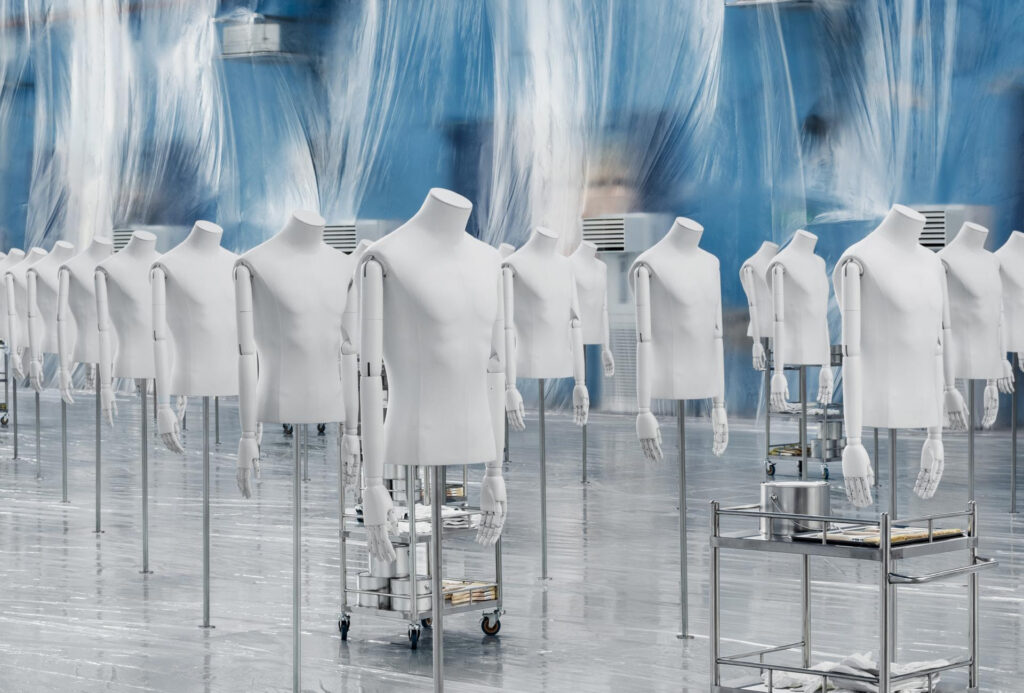
In an era where fashion often prioritizes the pristine and the permanent, Maison Margiela continues to champion the beauty of the ephemeral. This past weekend, the Maison brought its radical philosophy to the south of China, transforming the Hairun Badminton Courts in Shenzhen into a temporary extension of its Parisian creative hub.
Titled the Bianchetto: Atelier Experience, the event was a pivotal chapter in the larger MaisonMargiela/folders initiative—a multi-city takeover that has seen the house relocate its Fall/Winter 2026 runway debut from Paris to Shanghai, signaling a bold new era of transparency and engagement with the Chinese creative community.
Decoding Bianchetto: The Art of the Blank Canvas
The „Bianchetto“ technique is one of the most storied codes in the Margiela lexicon. Introduced by the house’s founder in 1989, it originated not on a runway, but in a studio. Tasked with furnishing the first Margiela office with a limited budget, the team famously overpainted salvaged furniture with white emulsion.
As a house code, Bianchetto is an act of „democratization through paint.“ By coating garments, footwear, and even entire interiors in thick white paint, the original identity of the object is obscured, leaving only a textured, hand-painted surface. Crucially, the paint is designed to crack and peel with every movement, documenting the wearer’s history and revealing the „soul“ of the item underneath.
The Shenzhen Experience: From Wardrobe to Archive
In Shenzhen, this concept moved from the theoretical to the tactile. Under the guidance of the Maison’s Atelier team—who traveled from Paris to facilitate the workshop—participants were invited to bring an item from their own wardrobes to be „Margiela-fied.“
Upon arrival, each guest was provided with a blouse blanche—the iconic white lab coat worn by all Margiela staff, from the seamstresses to the leadership. This gesture immediately leveled the hierarchy, inviting participants to step into the role of the „anonymous creator.“
As white paint was applied to leather jackets, denim, and cherished accessories, the visible brushstrokes transformed personal artifacts into collective art. The resulting pieces were no longer just clothing; they became physical „folders“—living documents of the Shenzhen weekend that will continue to evolve and „crack“ as they are worn back into the world.
A New Era of Radical Transparency
The Shenzhen workshop is part of a broader, revolutionary project: MaisonMargiela/folders. Following the Fall/Winter 2026 show in Shanghai, the Maison has embarked on a journey through four Chinese cities, each celebrating a distinct pillar of the brand:
-
Artisanal (Shanghai)
-
Anonymity (Beijing)
-
Tabi (Chengdu)
-
Bianchetto (Shenzhen)
Under the creative direction of Glenn Martens, the house is also challenging the traditional secrecy of luxury fashion. In tandem with the physical events, the Maison has made its internal digital working folders—hosted on Dropbox—accessible to the public. This „open-source“ approach allows fans to browse project timelines, research imagery, and exhibition documentation in real-time.
The Verdict
The Bianchetto experience in Shenzhen was more than a workshop; it was an invitation to participate in the „Rock ’n‘ Roll survival“ of a legendary house. By inviting the public into the Atelier’s inner workings, Maison Margiela proves that its most valuable asset isn’t just its archive—it’s the enduring, evolving ideas that fill it.