All Buildings of Architect Albert Frey – Palm Springs Desert Modernism – Midcentury Modern
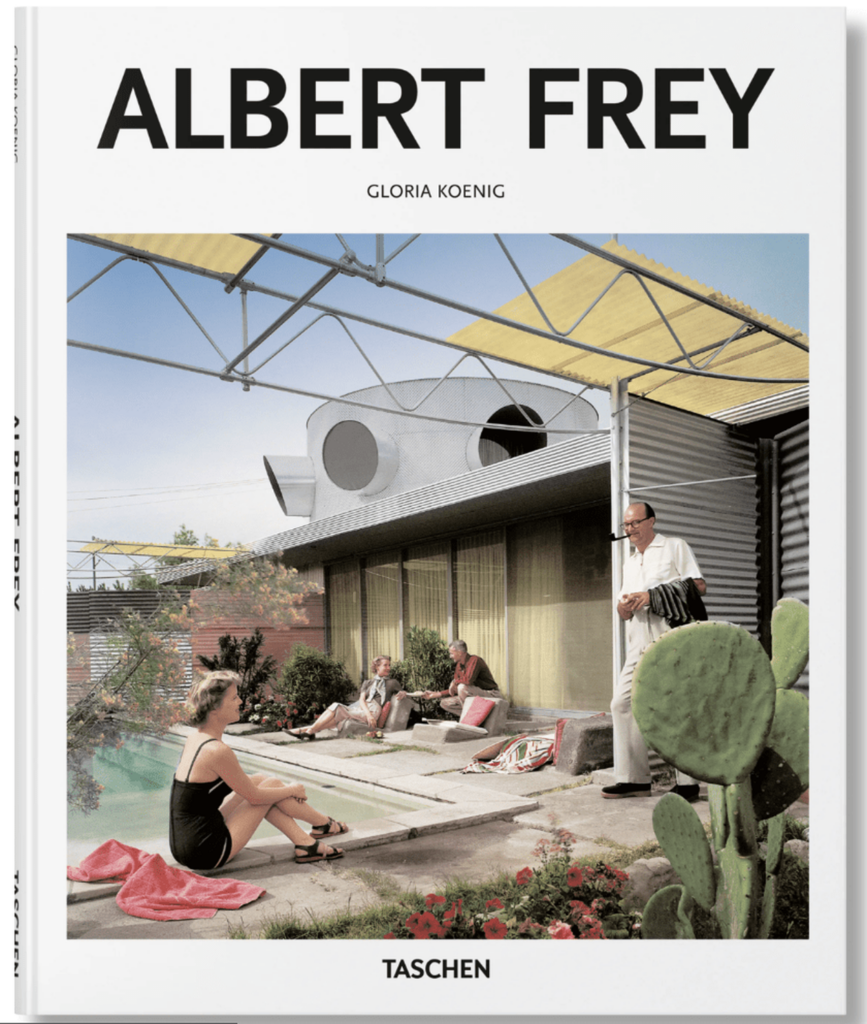
Albert Frey (1903-1998) is not just one of Palm Springs‘ architects – he is the architect who gave the desert its crystalline edge. A protege of Le Corbusier in Paris, Frey brought European modernist rigor to America and translated International Style principles into the shimmering desert light of California.
A Story by Award Winning Managing Editor His Highness Dr. Prince Mario-Max zu Schaumburg-Lippe.
His works are meditations in steel, glass, aluminum and concrete – structures that dissolve into the desert, where walls become windows, ceilings hover like clouds and mountains are framed as living art. His career spanned six decades, beginning in Europe and New York and flowering in Palm Springs, where his vision became synonymous with desert modernism.
From the Aluminaire House to Frey House II
Before Palm Springs, Frey worked under Le Corbusier in the late 1920s, contributing to projects such as the Villa Savoye. The Aluminaire House of 1931, built in 10 days from aluminum and steel with A. Lawrence Kocher, became an icon of the American International Style, and the Kocher-Sampson House of 1933 was his first desert house.
After moving permanently to Palm Springs in 1934, Frey created Frey House I in 1940 and his personal magnum opus, Frey House II, in 1964 – built into the rugged hillside above the Coachella Valley, with a boulder penetrating the living room wall. It is preserved today by the Palm Springs Art Museum. His civic icons include Palm Springs City Hall, the Tramway Valley Station and the Tramway Gas Station of 1965 with its famous flying wedge roof, known today as the Palm Springs Visitor Center.
Walter S. White worked alongside Frey during the 1940s, and their overlap was pivotal: White absorbed Frey’s rigor while Frey benefited from White’s inventiveness. Together they represent the spectrum of desert modernism – Frey the crystalline precision, White the lyrical wave.
ALBERT FREY – DER SCHWEIZER, DER DIE WUESTE ZUM GLAENZEN BRACHTE!
Er war der Star der Wueste! Albert Frey (1903-1998), einst Mitarbeiter von Le Corbusier in Paris, brachte die europaeische Moderne nach Palm Springs – und machte Stahl, Glas, Aluminium und Beton zu Poesie unter der kalifornischen Sonne.
Sein Aluminaire House von 1931 entstand in nur 10 Tagen und wurde zur Ikone des International Style. 1934 zog Frey fuer immer nach Palm Springs. Dort baute er 1940 das Frey House I und 1964 sein Meisterwerk, das Frey House II – mit einem Felsbrocken, der mitten durch die Wohnzimmerwand ragt! Heute bewahrt das Palm Springs Art Museum dieses Juwel.
Auch die City Hall, die Talstation der Seilbahn und die legendaere Tramway-Tankstelle von 1965 mit ihrem fliegenden Keildach stammen von Frey – sie ist heute das Besucherzentrum der Stadt. Und Walter S. White, der in den 1940ern an seiner Seite arbeitete, nahm Freys Praezision mit in die eigene Karriere. Frey gab Palm Springs die kristallklare Form – White den lyrischen Schwung. Zwei Sterne, ein Himmel: die Wuestenmoderne!
Der Autor ist Award Winning Hollywood Managing-Journalist Seine Hoheit und Exzellenz Dr.iur. Mag.iur. PRINZ MARIO-MAX ZU SCHAUMBURG-LIPPE, MAS, LL.M.
Prinz Mario-Max ist der Sohn der hochfürstlichen Würdenträger Seine Hoheit Dr. h. c. Prinz Waldemar zu Schaumburg-Lippe und Ihrer Hoheit Dr. Prinzessin Antonia zu Schaumburg-Lippe. Seine Großmutter ist Ihre Königliche Hoheit Prinzessin Feodora von Dänemark. Die Familie ist die königlich-dänische Nachoder Linie der Prinzen zu Schaumburg-Lippe, die Gründerfamilie von Hamburg, Lübeck und Kiel.
♔ Instagram: https://www.instagram.com/princemariomax/
Website: http://www.schaumburglippe.org
Facebook Seite: https://www.facebook.com/share/1EsNi5Q1AM/?mibextid=wwXlfr
Facebook: https://www.facebook.com/zuschaumburglippe
X / Twitter: https://twitter.com/schaumburglippe
LinkedIn: https://www.linkedin.com/in/prince-mario-max-schaumburg-lippe-1879978a
Also published on: