A $10,000 Prize for the Human Art of Translation at NYU
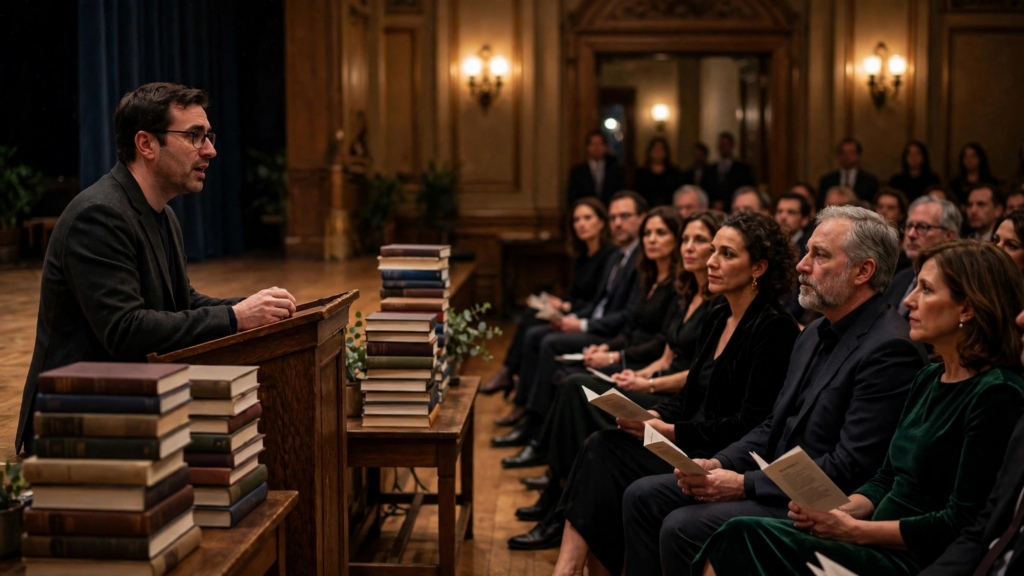
The Queen Sofia Spanish Institute presents its 2026 Translation Prize, a $10,000 award for the best English translation of a work originally written in Spanish, at the Espacio de Culturas @KJCC at New York University in New York City. The Institute describes the prize as the largest prize in the world for Spanish to English translators, and the ceremony pairs the winner announcement with a conversation titled „Creativity in Times of Crisis: AI & the Future of Human Literary Translation“, followed by a question and answer session and a Spanish-style cocktail party.
A Story by Award Winning Managing Editor His Highness Dr. Prince Mario-Max zu Schaumburg-Lippe.
Five books are on the 2026 shortlist. The Dance and the Fire by Daniel Saldaña París was translated by Christina MacSweeney and published by Catapult. We Are Green and Trembling by Gabriela Cabezón Cámara was translated by Robin Myers and published by New Directions. Cautery by Lucía Lijtmaer was translated by Maureen Shaughnessy and published by Charco Press. Carnaval Fever by Yuliana Ortiz Ruano was translated by Madeleine Arenivar and published by Soft Skull Press. Galápagos by Fátima Vélez was translated by Hannah Kauders and published by Astra House. The shortlist of five was selected from a longlist of ten titles.
The reading committee for this edition was chaired by Heather Cleary, who won the prize in 2024. Lisa Dillman, the 2025 winner, served on the committee with Gwendolyn Harper, a past runner-up. Cleary won in 2024 for her translation of Recital of the Dark Verses by Luis Felipe Fabre, published by Deep Vellum. She teaches at Sarah Lawrence College, holds a PhD from Columbia University, and is a 2026 Guggenheim Fellow. She also speaks at the ceremony, which puts the chair of the reading committee on the same program as the translators she helped select.
For the 250th anniversary of relations between Spain and the United States, covering the years 1776 to 2026, each non-winning shortlisted title receives $250. The payment applies to the four titles that do not take the main prize, so all five books on the shortlist leave the ceremony with an award. Cultural diplomacy between Spain and the United States has been visible in New York and Madrid in recent days, including King Felipe receiving six new ambassadors at the Royal Palace of Madrid and the earlier Queen Sofia music prize presentation in Madrid.
Begoña Santos, President and CEO of the Queen Sofia Spanish Institute, is among the speakers. Pedro Calvo-Sotelo, Consul for Cultural Affairs at the Consulate General of Spain in New York, also speaks. Katie Raissian, Executive Editor at Scribner, joins the program from the publishing side, where editors decide which translated books are acquired for English language readers. The conversation brings translators, an editor and a computer scientist into one discussion about literary translation.
Smaranda Muresan completes the speaker list. She is Associate Professor and Associate Chair of Computer Science at Barnard College, Columbia University, and her research covers natural language processing. Her work sits at the centre of the ceremony theme, because natural language processing is the field behind the machine translation systems that the panel discusses alongside human literary translation. The title of the conversation names artificial intelligence directly, and the program places Muresan alongside Cleary, whose own work depends on close reading of voice, rhythm and word choice in Spanish and English.
The ceremony also includes a special announcement from Jeannette L. Clariond. Clariond is a Mexican poet born in Chihuahua in 1949. She has translated Anne Carson into Spanish, including Nox and Decreation, and she has translated more than twenty books in total, with work by Elizabeth Bishop, Primo Levi and Charles Wright among them. The Institute has listed her announcement as a separate item on the ceremony program.
Carson won the 2026 Nobel Prize in Literature, announced by the Swedish Academy on October 8, 2026. That result gives Clariond a particular place in the evening. She is the Spanish language translator of the newest Nobel laureate in literature, speaking at a ceremony for a prize that honours translation in the opposite direction, from Spanish into English. Readers in New York who follow the city cultural calendar can also read about six fashion and beauty pop-ups opening in New York in the same week.
The Queen Sofia Spanish Institute is a New York nonprofit founded in 1954 by American Hispanophiles. It is named for Queen Sofía of Spain. The Translation Prize is now in its ninth edition. In nine editions the prize has built a record that links Spanish language authors with English language publishers in the United States, and the 2026 shortlist covers publishers in several cities, from Catapult and New Directions to Charco Press, Soft Skull Press and Astra House. After the winner is announced and the conversation ends, guests move to the question and answer session and then to the Spanish-style cocktail party that closes the program.
10.000 Dollar für die beste Übersetzung: New York feiert die Kunst der Worte
NEW YORK – Es geht um 10.000 Dollar, um fünf starke Bücher und um eine Frage, die die Literaturwelt bewegt. Das Queen Sofia Spanish Institute vergibt seinen Translation Prize 2026 für die beste englische Übersetzung eines Werkes, das ursprünglich auf Spanisch geschrieben wurde. Das Institut nennt den Preis den größten Preis der Welt für Übersetzer aus dem Spanischen ins Englische. Schauplatz ist das Espacio de Culturas @KJCC an der New York University in New York City. Nach der Bekanntgabe des Gewinners folgt ein Gespräch mit dem Titel „Creativity in Times of Crisis: AI & the Future of Human Literary Translation“, danach eine Fragerunde und eine Cocktailparty im spanischen Stil.
Fünf Titel stehen auf der Shortlist 2026. The Dance and the Fire von Daniel Saldaña París, übersetzt von Christina MacSweeney, erschienen bei Catapult. We Are Green and Trembling von Gabriela Cabezón Cámara, übersetzt von Robin Myers, erschienen bei New Directions. Cautery von Lucía Lijtmaer, übersetzt von Maureen Shaughnessy, erschienen bei Charco Press. Carnaval Fever von Yuliana Ortiz Ruano, übersetzt von Madeleine Arenivar, erschienen bei Soft Skull Press. Und Galápagos von Fátima Vélez, übersetzt von Hannah Kauders, erschienen bei Astra House. Die Shortlist mit fünf Titeln wurde aus einer Longlist mit zehn Titeln ausgewählt.
Den Leseausschuss leitete Heather Cleary, die Gewinnerin des Jahres 2024. Mit dabei waren Lisa Dillman, Gewinnerin 2025, und Gwendolyn Harper, eine frühere Zweitplatzierte. Cleary gewann 2024 für ihre Übersetzung von Recital of the Dark Verses von Luis Felipe Fabre, erschienen bei Deep Vellum. Sie lehrt am Sarah Lawrence College, hat einen Doktortitel der Columbia University und ist Guggenheim Fellow 2026. Bei der Zeremonie tritt sie auch als Sprecherin auf.
Zum 250. Jubiläum der Beziehungen zwischen Spanien und den Vereinigten Staaten, gerechnet von 1776 bis 2026, erhält jeder nicht siegreiche Titel der Shortlist 250 Dollar. Damit geht keiner der fünf Finalisten leer aus. Alle fünf Bücher verlassen die Zeremonie mit einer Auszeichnung.
Zu den Sprechern gehören Begoña Santos, Präsidentin und CEO des Queen Sofia Spanish Institute, und Pedro Calvo-Sotelo, Konsul für Kulturangelegenheiten am Generalkonsulat von Spanien in New York. Katie Raissian, Executive Editor bei Scribner, bringt die Sicht des Verlagshauses ein. Smaranda Muresan ist Associate Professor und Associate Chair für Informatik am Barnard College der Columbia University. Ihre Forschung gilt der Verarbeitung natürlicher Sprache, also genau dem Feld, aus dem die Systeme für maschinelle Übersetzung kommen, über die an diesem Abend mit menschlichen Literaturübersetzern diskutiert wird.
Ein Höhepunkt ist eine besondere Ankündigung von Jeannette L. Clariond. Die mexikanische Dichterin, geboren 1949 in Chihuahua, hat Anne Carson ins Spanische übersetzt, darunter Nox und Decreation. Mehr als zwanzig Bücher hat sie übersetzt, darunter Werke von Elizabeth Bishop, Primo Levi und Charles Wright.
Anne Carson gewann den Nobelpreis für Literatur 2026, verkündet von der Schwedischen Akademie am 8. Oktober 2026. Damit steht Clariond als spanische Übersetzerin der neuen Literatur-Nobelpreisträgerin im Mittelpunkt eines Abends, der sonst Übersetzungen aus dem Spanischen ins Englische ehrt. Die Richtung wechselt, die Botschaft bleibt gleich: Ohne Übersetzer erreichen Bücher ihre Leser in anderen Sprachen nicht.
Das Queen Sofia Spanish Institute ist eine New Yorker Non-Profit-Organisation, gegründet 1954 von amerikanischen Hispanophilen und benannt nach Königin Sofía von Spanien. Der Translation Prize findet 2026 in seiner neunten Ausgabe statt. Nach Bekanntgabe, Gespräch und Fragerunde endet das Programm mit der Cocktailparty im spanischen Stil.
Der Autor ist Award Winning Hollywood Managing-Journalist Seine Hoheit und Exzellenz Dr.iur. Mag.iur. PRINZ MARIO-MAX ZU SCHAUMBURG-LIPPE, MAS, LL.M.
Prinz Mario-Max ist der Sohn der hochfürstlichen Würdenträger Seine Hoheit Dr. h. c. Prinz Waldemar zu Schaumburg-Lippe und Ihrer Hoheit Dr. Prinzessin Antonia zu Schaumburg-Lippe. Seine Großmutter ist Ihre Königliche Hoheit Prinzessin Feodora von Dänemark. Die Familie ist die königlich-dänische Nachoder Linie der Prinzen zu Schaumburg-Lippe, die Gründerfamilie von Hamburg, Lübeck und Kiel.
♔ Instagram: https://www.instagram.com/princemariomax/
Website: http://www.schaumburglippe.org
Facebook Seite: https://www.facebook.com/share/1EsNi5Q1AM/?mibextid=wwXlfr
Facebook: https://www.facebook.com/zuschaumburglippe
X / Twitter: https://twitter.com/schaumburglippe
LinkedIn: https://www.linkedin.com/in/prince-mario-max-schaumburg-lippe-1879978a
This story was also published by News Today World, NYLA News, Mario-Max Magazine, Revista Minutos, Le Miroir Français, China Daily News.