The Maltese Falcon Returns for Its 85th Anniversary
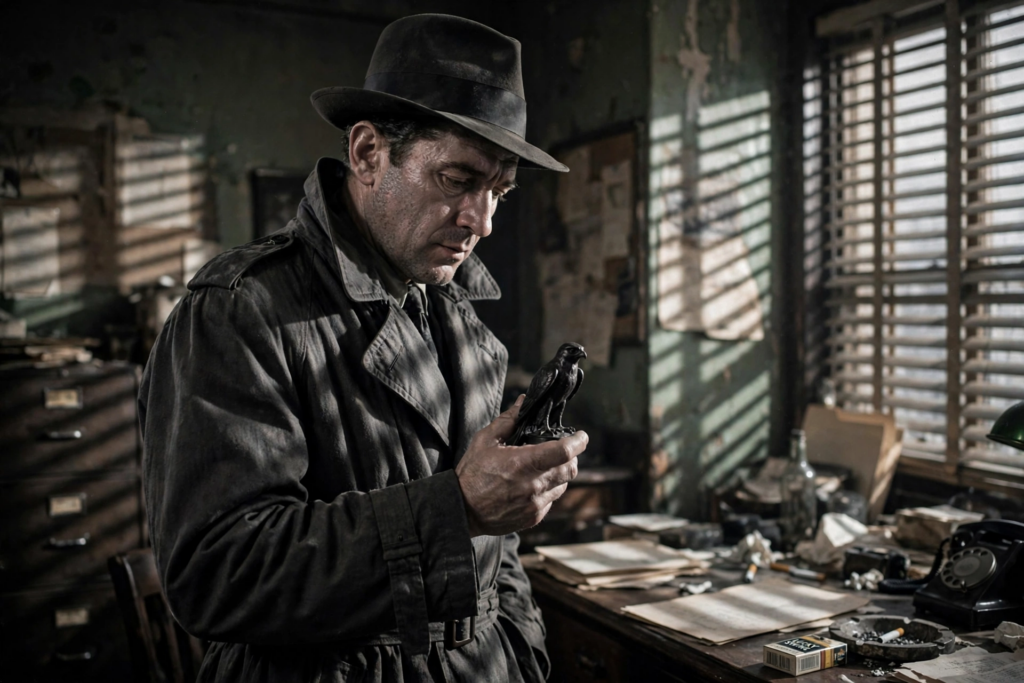
The Maltese Falcon returns to theaters on December 6 and 9, 2026, for its 85th anniversary, presented by Fathom Entertainment in its Big Screen Classics series. Warner Bros. has prepared a new 4K trailer for the engagement, and each screening includes filmed insight from critic and historian Leonard Maltin. The film opened in October 1941, cost a reported $375,000 to make, and has been imitated ever since.
A Story by Award Winning Managing Editor His Highness Dr. Prince Mario-Max zu Schaumburg-Lippe.
John Huston directed it as his first film, adapting Dashiell Hammett’s 1930 novel with unusual fidelity and writing the screenplay himself. Humphrey Bogart plays Sam Spade, a San Francisco private detective whose partner is murdered while shadowing a client. The client, who calls herself Miss Wonderly and then Brigid O’Shaughnessy, is played by Mary Astor. What follows is a hunt for a jewel-encrusted statuette of a falcon, pursued by a cast of liars who are all more frightened than they admit.
Sydney Greenstreet made his film debut at 61 as Kasper Gutman, the courteous, enormous villain who explains the falcon’s history over drinks and never loses his temper. Peter Lorre plays Joel Cairo, all gardenia scent and nerves. Elisha Cook Jr. is Wilmer, the young gunsel who keeps being disarmed. Ward Bond and Barton MacLane handle the police. Every performance is exact, and Huston’s camera mostly stays out of the way, letting scenes run in long takes built on dialogue rhythm rather than cutting.
It was not the first attempt at the book. Warner Bros. had filmed Hammett’s novel in 1931 under its own title and again in 1936 as Satan Met a Lady, with Bette Davis, and neither version settled. Huston, who had been a successful screenwriter at the studio, asked for the property as his directing debut and took the unfashionable path of trusting the source. He kept Hammett’s dialogue nearly intact, staged the confrontations in the rooms where Hammett put them, and cast Bogart, then known mainly for supporting gangster roles, in the part that reset his career. The studio backed the picture modestly and released it in the autumn of 1941, weeks before the country entered the war, and word of mouth did the rest.
The picture’s reputation rests on firmer ground than nostalgia. It was nominated for three Academy Awards, including Best Picture and Best Supporting Actor for Greenstreet. The American Film Institute has kept it on its lists of the greatest American films, and the Library of Congress selected it for the National Film Registry in 1989, in the registry’s first year. Film historians routinely credit it with setting the template for film noir: the venetian-blind lighting, the faithless client, the detective whose code is private and non-negotiable.
Seeing it in a theater changes the balance of the film. Arthur Edeson’s black-and-white photography is built from deep shadows and hard highlights that flatten on a small screen and open up at scale. Spade’s office, the hotel corridors and Gutman’s suite become architecture rather than backdrop. The dialogue, which audiences quote from memory, lands differently in a room full of people, because so much of it is funny in a dry, dangerous way that solitary viewing tends to miss.
Warner Bros. has been a steady presence in this season’s movie news, from the anniversary program to development stories like Rian Johnson’s new paranoid thriller, a genre that owes this film a direct debt. The paranoid thrillers of the 1970s, and the neo-noir wave after them, all trace back to the structure Hammett built and Huston shot: a professional man, a valuable object, a room full of people performing innocence.
One pleasure of the anniversary circuit is watching a film meet an audience that knows it only as a reference. The Maltese Falcon survives that meeting easily, because its pleasures are not period pleasures. The plot is a machine, the performances are modern in their restraint, and Bogart’s Spade, smiling while he dismantles a room of criminals, remains the definitive screen detective. The famous closing line about the stuff that dreams are made of was reportedly improvised into the script late, and it still gets a laugh and a chill at once.
The 85th anniversary screenings run on December 6 and 9, 2026, at participating theaters nationwide, with Maltin’s introduction included in the program. For anyone building a December calendar of classics, this is the noir entry, and it pairs naturally with the month’s other anniversary titles, among them Moulin Rouge! and its December 12 and 13 screenings. Two dates only, and evening shows on the 9th tend to draw the most devoted crowds, which is exactly the company this film deserves.
Der Malteser Falke wird 85 – Bogart als Sam Spade zurueck im Kino
„Der Malteser Falke“ kehrt am 6. und 9. Dezember 2026 zum 85. Jubilaeum in die Kinos zurueck, praesentiert von Fathom Entertainment in der Reihe Big Screen Classics. Warner Bros. hat einen neuen 4K-Trailer fuer den Einsatz vorbereitet, jede Vorstellung enthaelt gefilmte Einordnungen des Kritikers und Historikers Leonard Maltin. Der Film startete im Oktober 1941, kostete kolportierte 375.000 Dollar – und wird seitdem imitiert.
John Huston drehte ihn als seinen ersten Film, er verfilmte Dashiell Hammetts Roman von 1930 mit ungewoehnlicher Treue und schrieb das Drehbuch selbst. Humphrey Bogart spielt Sam Spade, einen Privatdetektiv in San Francisco, dessen Partner ermordet wird, waehrend er eine Klientin beschattet. Die Klientin, die sich erst Miss Wonderly und dann Brigid O’Shaughnessy nennt, spielt Mary Astor. Was folgt, ist die Jagd nach einer juwelenbesetzten Falkenstatuette, verfolgt von einer Besetzung von Luegnern, die alle mehr Angst haben, als sie zugeben.
Sydney Greenstreet gab mit 61 sein Filmdebuet als Kasper Gutman, der hoefliche, riesige Boesewicht, der bei Drinks die Geschichte des Falken erzaehlt und nie die Fassung verliert. Peter Lorre spielt Joel Cairo, ganz Gartennelken-Duft und Nerven. Elisha Cook Jr. ist Wilmer, der junge Revolvermann, der staendig entwaffnet wird. Ward Bond und Barton MacLane uebernehmen die Polizei. Jede Darstellung sitzt exakt, und Hustons Kamera haelt sich meist zurueck: Szenen laufen in langen Einstellungen, gebaut auf Dialogrhythmus statt auf Schnitte.
Es war nicht der erste Versuch mit dem Buch. Warner Bros. hatte Hammetts Roman 1931 unter eigenem Titel verfilmt und 1936 noch einmal als „Satan Met a Lady“ mit Bette Davis – keine der beiden Versionen setzte sich durch. Huston, bis dahin erfolgreicher Drehbuchautor des Studios, bat um den Stoff als sein Regiedebuet und waehlte den unmodischen Weg, der Vorlage zu vertrauen. Er liess Hammetts Dialoge fast unveraendert, inszenierte die Konfrontationen in den Raeumen, in die Hammett sie gelegt hatte, und besetzte Bogart – damals vor allem fuer Gangster-Nebenrollen bekannt – mit der Rolle, die seine Karriere neu startete. Das Studio finanzierte bescheiden, der Film startete im Herbst 1941, Wochen bevor das Land in den Krieg eintrat, und die Mundpropaganda erledigte den Rest.
Der Ruf des Films steht auf festerem Grund als Nostalgie. Er wurde fuer drei Oscars nominiert, darunter Bester Film und Bester Nebendarsteller fuer Greenstreet. Das American Film Institute fuehrt ihn auf seinen Listen der groessten amerikanischen Filme, die Library of Congress nahm ihn 1989 in das National Film Registry auf, im ersten Jahr des Registers. Filmhistoriker schreiben ihm regelmaessig zu, die Vorlage des Film noir gesetzt zu haben: das Jalousien-Licht, die treulose Klientin, der Detektiv, dessen Kodex privat und nicht verhandelbar ist.
Im Kino veraendert sich die Balance des Films. Arthur Edesons Schwarzweiss-Fotografie ist aus tiefen Schatten und harten Lichtern gebaut, die auf einem kleinen Bildschirm flach wirken und in gross aufbluhen. Spades Buero, die Hotelflure und Gutmans Suite werden Architektur statt Kulisse. Die Dialoge, die das Publikum auswendig zitiert, landen in einem vollen Saal anders, weil so viel davon auf trockene, gefaehrliche Art komisch ist – eine Qualitaet, die beim einsamen Schauen leicht untergeht.
Ein Vergnuegen des Jubilaeums-Zirkus ist es, einen Film auf ein Publikum treffen zu sehen, das ihn nur als Referenz kennt. „Der Malteser Falke“ besteht dieses Treffen muehelos, denn seine Vergnuegen sind keine Epochen-Vergnuegen. Die Handlung ist eine Maschine, die Darstellungen sind modern in ihrer Zurueckhaltung, und Bogarts Spade, der laechelnd einen Raum voller Verbrecher demontiert, bleibt der definitive Leinwand-Detektiv. Der beruehmte Schlusssatz vom Stoff, aus dem die Traeume sind, soll spaet und improvisiert ins Drehbuch gekommen sein – er holt noch immer ein Lachen und einen Schauer zugleich.
Die Vorstellungen zum 85. Jubilaeum laufen am 6. und 9. Dezember 2026 in teilnehmenden Kinos landesweit, Maltins Einfuehrung ist Teil des Programms. Zwei Termine nur – und die Abendvorstellungen am 9. ziehen erfahrungsgemaess die treuesten Fans an, genau die Gesellschaft, die dieser Film verdient.
Readers can also find this report at News Today World, Le Miroir Francais, Schaumburg Post, China Daily News, American Pulse Journal, Revista Minutos.

Der Autor ist Award Winning Hollywood Managing-Journalist Seine Hoheit und Exzellenz Dr.iur. Mag.iur. PRINZ MARIO-MAX ZU SCHAUMBURG-LIPPE, MAS, LL.M.
Prinz Mario-Max ist der Sohn der hochfürstlichen Würdenträger Seine Hoheit Dr. h. c. Prinz Waldemar zu Schaumburg-Lippe und Ihrer Hoheit Dr. Prinzessin Antonia zu Schaumburg-Lippe. Seine Großmutter ist Ihre Königliche Hoheit Prinzessin Feodora von Dänemark. Die Familie ist die königlich-dänische Nachoder Linie der Prinzen zu Schaumburg-Lippe, die Gründerfamilie von Hamburg, Lübeck und Kiel.
♔ Instagram: https://www.instagram.com/princemariomax/
Website: http://www.schaumburglippe.org
Facebook Seite: https://www.facebook.com/share/1EsNi5Q1AM/?mibextid=wwXlfr
Facebook: https://www.facebook.com/zuschaumburglippe
X / Twitter: https://twitter.com/schaumburglippe
LinkedIn: https://www.linkedin.com/in/prince-mario-max-schaumburg-lippe-1879978a